Speaker for 10th September 2019
Coleraine Probus and the 1919 Conference that changed the world
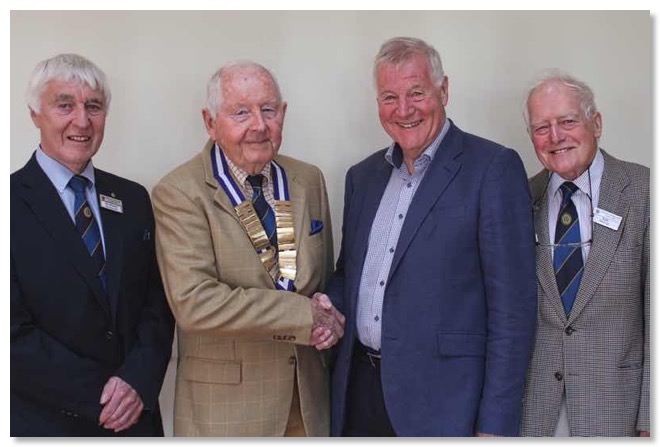
Probus members knew that they would be hearing about an important historical event, when Alan Sharpe gave a recent talk to the club titled 'Versailles 1919 - A Centennial Perspective'. However, most members wouldn't have believed just how much of our world today had been moulded by the outcome that extraordinary Paris conference.
Alan started his impeccably researched and illustrated presentation with some points to ponder - What would the World look like today IF the First World War had NOT happened? There may have been no Russian Revolution?; The Austria - Hungary 'Empire' may have survived as it was?; Germany may have evolved into a parliamentary democracy?; There may be no Fascism or Communism or National Socialism?; Perhaps no WWII?; No 'Cold War'?; The USA may not be the 'World Leader' it is today?; And perhaps Ireland may have remained as part of the UK?
But there was a war, and the costs of this were enormous, the like of which had never been seen before. It is estimated that 8 to 10 million men were killed. Another 20 to 30 million received life changing injuries, and as many as 60 millions or more were 'incidental casualties'. The overall costing to the 'Victors', at 1919 prices, was around £24,000 million - what that would be at today's rate, is probably too big to imagine!
At the end of the war, it was generally agreed that such terrible carnage should never be allowed to happen again, and the 'Big Four' world leaders should convene a conference in Paris to agree how that could be achieved. In the January of 1919, Lloyd George of Britain, Vittorio Emanuele Orlando of Italy, Georges Clemenceau of France, and Woodrow Wilson of the U.S. headed delegations from 32 countries and nations, to negotiate a treaty that would lead to a future of peace. They should determine what and how Germany and their allies, should pay in reparations for cost of the war, and Germany with their allies, as defeated nations, were not invited to the conference.
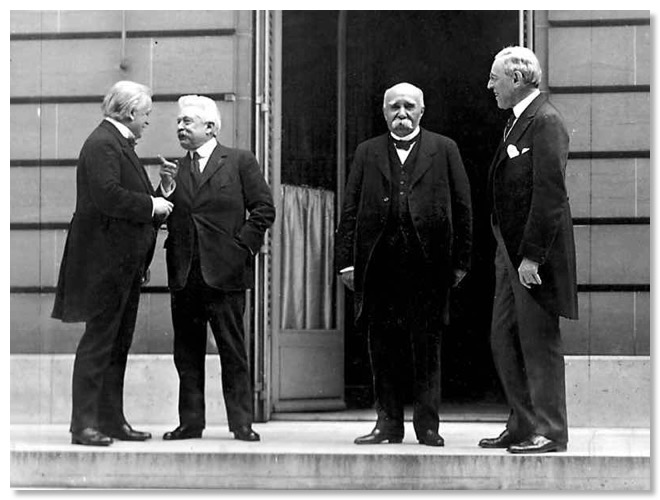
The 'Big Four'
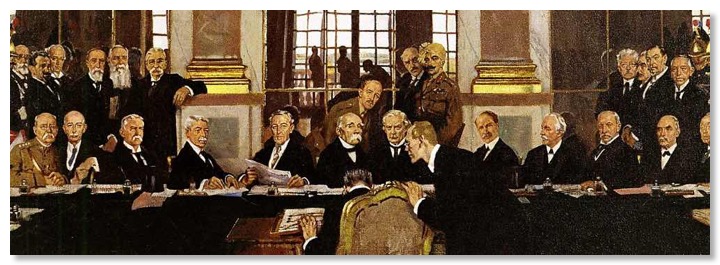
The Paris Versailles Conference is unique in many ways. Mainly due to the fact that it lasted, officially, from January 1919 until the end of June that year*, with the four main leaders there in person, and away from their home duties as 'First Ministers'. The 'Conference' met 145 times during that time and slowly agreed the final signing of treaty in Versailles famous 'Hall of Mirrors.
In general the treaty set up a legacy that is relevant in today's world. It established laws and human rights; it paved the way to setting up the 'League of Nations' (the forerunner to the 'United Nations'); it redrew the map of Europe and the Middle East (nearer to what we see today); and it set out the steps for national self-determination. In addition, the treaty set aspirational goals, stating that 'War Crimes' extended beyond the operational activities of war - hence giving the basis in latter years for Nuremberg, Tokyo and the ICC at The Hague. It encouraged the idea of 'asking the people' (with national referendums) as well as 'Votes for Women' in plebiscites, as well as protection for minorities.
Perhaps the biggest legacy of the treaty is found in 'Article 427' which suggests the right to join a union; payment of 'a living wage'; an 8 hour working day; a weekly rest day; and equal pay for equal work for women.
Alan's talk was as fascinating as it was expertly presented, and club members who may have found it difficult to remember all the myriad of facts and details, were pleased to learn that Alan has produced a book with all the information, and more, from his talk. It has the same title as the presentation, and should be in the Coleraine Library, or on the shelves at Eason's and Waterstone's in town. One for the Christmas list this year?
Note* Although the senior statesmen stopped working personally on the conference in June 1919, the formal peace process did not really end until July 1923, when the Treaty of Lausanne, the last of five additional treaties, for different regions, was signed.
Members may wish to 'Click' the book link below to read a review find out more about Alan's book.
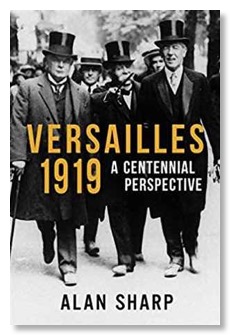
For another perspective on the 1919 Peace Conference. 'Click' on the image below (this will also open in a new window):